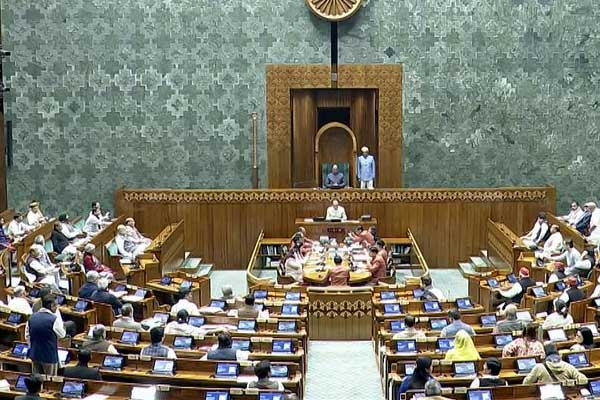
(Image source from: Twitter.com/LokSabhaSectt)
Parliament will discuss 13 important bills during the winter session that started on Monday. This session will include 15 meetings and will last until December 19. The discussions on Private Members’ Bills are scheduled for December 5 and 19, while Private Members’ resolutions will be looked at on December 12. The financial discussions will involve presenting, debating, and voting on the first group of additional grant requests for the year 2025-26, along with introducing, considering, and finalizing the related Appropriation Bill. Below are the Bills:
Jan Vishwas (Amendment of Provisions) Bill, 2025: This Bill seeks to continue the changes started by the 2023 version of the Jan Vishwas Act, further reducing criminal implications for minor wrongdoings and making regulatory compliance simpler across various sectors. The 2025 Bill proposes changes to 355 sections in about 16 Central Acts: 288 sections will be changed to remove criminal penalties (switching them for civil or administrative ones), and 67 sections will be modified to lessen the burdens of compliance. Major updates include that first-time offenders for 76 specified offenses might only get warnings or improvement notices; many existing jail or fine punishments for technical or procedural errors will be replaced with monetary fines or warnings; and fines will automatically increase by 10% every three years to keep deterrents effective without needing new laws often. The Bill is part of a larger effort towards “trust-based governance," moving away from harsh criminal penalties for small violations to fairer administrative measures, thus easing the pressure on courts and enhancing business operations.
Insolvency and Bankruptcy Code (Amendment) Bill, 2025: This Bill suggests important changes to the current Insolvency and Bankruptcy Code, 2016 (IBC) to solve ongoing problems in the insolvency resolution process. It introduces a new “Creditor-Initiated Insolvency Resolution Process" (CIIRP) — which allows certain financial lenders to begin insolvency procedures through an out-of-court method, avoiding immediate action in tribunal court. This Bill is claimed to be the most significant change to the insolvency rules since the IBC was created — aiming for quicker resolutions, better financial preservation, more predictability, and alignment with international best practices.
Manipur Goods and Services Tax (Second Amendment) Bill, 2025: This Bill updates the earlier 2025 Ordinance that revised the Manipur Goods and Services Tax Act, 2017 — which was necessary because the state's legislative body is under Presidential rule, requiring Parliament to approve the updates. The Bill matches Manipur’s GST laws with changes made to the central GST law (through the 2025 Finance Act). It establishes guidelines for dealing with tax liabilities related to unpaid taxes, underpaid amounts, incorrect refunds, or improper use of input tax credit (ITC) starting from the financial years 2024–25; officials must send notices within 42 months of the deadline or refund date. The Bill lowers the “pre-deposit" requirement for appealing against tax demands from 20% of the disputed amount to 10%, and reduces the maximum limits for appeals before the Appellate Authority or Tribunal, cutting them down from ₹25 crore and ₹50 crore to ₹20 crore.
It also changes the deadlines for appeals — allowing the state government to decide to lengthen the time for filing past the former three months to a new date as announced.
The Central Excise (Amendment) Bill, 2025: The Central Excise Amendment Bill, 2025, will replace the GST compensation Cess that is currently applied to all tobacco products such as cigarettes, chewing tobacco, cigars, hookahs, flavored tobacco, and zarda. The aim of the Central Excise (Amendment) Bill, 2025, is “to give the government the financial flexibility to raise the rate of central excise duty on tobacco and tobacco products to maintain tax levels," after the GST compensation Cess concludes, based on the Bill's statement of objectives and reasons.
The Health Security se National Security Cess Bill, 2025: The Health Security se National Security Cess Bill, 2025, plans to impose a Cess on the production of certain goods like pan masala. The Government might announce additional items on which this Cess can be imposed. Goods considered harmful, such as tobacco and pan masala, currently have a GST of 28 percent, along with a compensation Cess that is charged at different rates. Once the compensation Cess is removed, the sale of tobacco and related products will incur GST in addition to excise duty, while pan masala will be subjected to GST together with the Health Security se National Security Cess. Since the GST of 28 percent is no longer applicable, these harmful goods will fall under the highest GST category of 40 percent.
Repealing and Amending Bill, 2025: This Bill aims to revoke and modify a collection of outdated or unnecessary laws — part of the government's ongoing efforts to clean up legislation, eliminate old regulations, and simplify the regulatory system.
National Highways (Amendment) Bill, 2025: This Bill is among the important proposals for the Winter Session. Its goal is to facilitate quicker and more transparent land acquisition for projects related to national highways.
Atomic Energy Bill, 2025: This Bill is one of the 13 proposals scheduled for the session. Its main purpose is to update and regulate the nuclear energy industry.
Corporate Laws (Amendment) Bill, 2025: This Bill intends to revise major corporate laws (specifically the Companies Act, 2013, and the Limited Liability Partnership Act, 2008) to enhance the ease of conducting business and modernize corporate regulations.
Securities Markets Code Bill, 2025 (SMC): The SMC aims to merge three existing national laws that regulate securities markets — the Securities and Exchange Board of India Act, 1992 (SEBI Act), the Depositories Act, 1996, and the Securities Contracts (Regulation) Act, 1956 — into one single “Securities Markets Code." The objective is to clarify and simplify the regulation of capital markets, presumably making compliance easier, minimizing overlap and duplication in laws, and improving the overall regulatory framework.
Insurance Laws (Amendment) Bill, 2025: This Bill is designed to modernize and speed up the growth of the insurance industry in India.
Arbitration and Conciliation (Amendment) Bill, 2025: This proposed law aims to change the Arbitration and Conciliation Act of 1996, which is the main regulation for arbitration in India.
Higher Education Commission of India Bill, 2025: This proposed law is part of a set of 13 bills scheduled for discussion during the Winter Session.