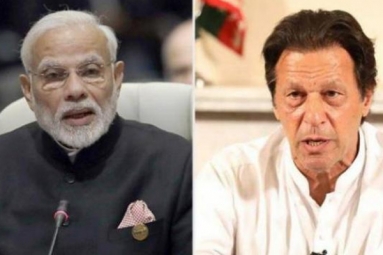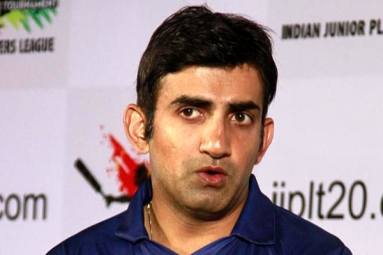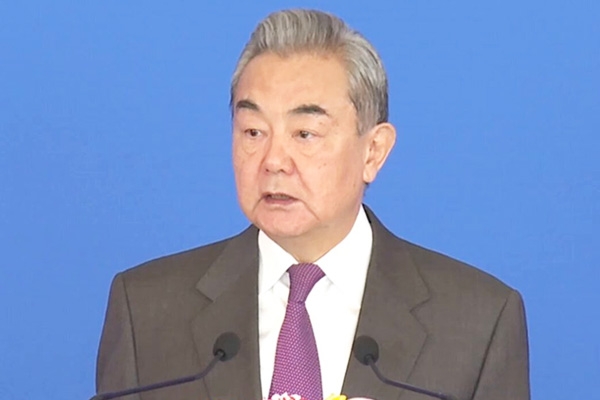
(Image source from: Twitter.com/MFA_China)
After US President Donald Trump, China has taken credit for helping to promote peace between India and Pakistan during the military fighting that occurred earlier this year, even though New Delhi has continuously rejected any outside involvement. Similar to Trump, the Chinese Foreign Minister has also presented Beijing as a mediator in other international issues, such as the problems in northern Myanmar, the conflict between Cambodia and Thailand, and the Iranian nuclear situation. "This year, small wars and clashes across borders have increased more than at any point since World War II ended. Geopolitical unrest continued to expand... To create lasting peace, we have maintained a fair and balanced position, focusing on both the symptoms and the underlying causes," said Foreign Minister Wang Yi while speaking at a symposium in Beijing about international affairs and China's foreign policy.
Wang Yi then stated that "conflicts between India and Pakistan" were on the list of critical issues "mediated" by China this year. "By following this Chinese way to resolve hotspot issues, we acted in northern Myanmar, the Iranian nuclear situation, the conflict between Pakistan and India, the issues involving Palestine and Israel, and the recent clash between Cambodia and Thailand," he said. New Delhi has asserted that the military conflict between India and Pakistan, which began on May 7, was settled through direct communication between the DGMOs, the heads of military operations of both nations. In a May 13 news briefing, the Ministry of External Affairs stated, "Concerning the ceasefire and the involvement of other countries, the specific date, time, and details of the agreement were arranged between the DGMOs in their call on May 10, 2025, starting at 15:35 hours." India has consistently argued that there is no room for third-party interference in issues related to India and Pakistan.
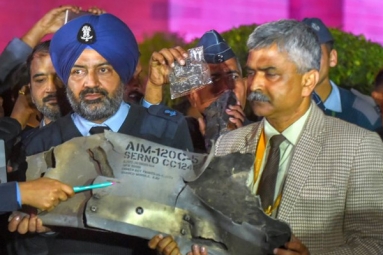
China's involvement in the May 7-10 Operation Sindoor faced significant scrutiny and backlash, particularly regarding the military support offered by Beijing to Islamabad. On the diplomatic side, Beijing urged both India and Pakistan on May 7 to show restraint, even while expressing disappointment over India's airstrikes. "China considers India's military action this morning regrettable," said a statement from the Chinese Foreign Ministry in response to inquiries about India's airstrikes and the rising tensions. The statement, which did not mention Pakistan by name, asserted that "China stands against all forms of terrorism," referring indirectly to the Pahalgam terrorist attack and called on both parties to show restraint for the sake of peace. However, China's ongoing military assistance to Pakistan during Operation Sindoor has highlighted the damaging effects of Beijing and Islamabad's close relationship on their ties with New Delhi.
In relation to China, which sells over 81 percent of Pakistan's military supplies, the country tried to lessen the impact of India's claim that it used the conflict as a testing ground. China chose not to directly respond to the accusations made by Deputy Chief of Army Staff, Lt General Rahul R Singh. Gen Singh stated that China's approach during Operation Sindoor was influenced by its classic military tactics known as "36 stratagems" and the concept of harming an enemy with another's resources to emphasize that Beijing provided significant support to Pakistan to inflict suffering on India. In his discourse about China’s international policy efforts, Wang Yi remarked on the positive progress in the relationship between India and China while mentioning Beijing's invitation to Prime Minister Narendra Modi for the Shanghai Cooperation Organisation (SCO) summit, which took place in Tianjin last August. "This year, we invited leaders from India and North Korea to visit China. The relationship between China and India has experienced positive growth, and our traditional friendship with the DPRK has been reinforced and further developed," he noted, claiming that the SCO summit was a considerable triumph. The Foreign Minister asserted that China's ties with neighboring nations have entered a new phase aimed at creating a community with a shared future more quickly.
Referring to US President Donald Trump's implementation of tariffs on China and other countries, Wang Yi stated, "This year, economic globalization faced serious obstacles. The trade war impacted international trade rules and disturbed the global economic framework. The choice between being open and isolated has become crucial." He emphasized that the relationship between China and the United States is one of the most significant bilateral ties in today’s world. "The strategic decisions of both nations will influence the direction of world history," he remarked. "On critical issues of principle, we stood firm and clear. On matters related to China's essential interests, we responded strongly and maintained our position," he added.
At the same time, we cooperated and communicated with the US to promote collaboration, encourage a more rational and objective view of China, and resolve differences through talks and discussions, he mentioned. Both Trump and Chinese President Xi Jinping, through their regular engagements, have "navigated the complex journey of China-US relations and guided it towards a better path," he stated. China and the US need to pursue solutions to their respective issues based on fairness, mutual respect, and reciprocity, finding an appropriate way for the two leading nations to coexist peacefully.