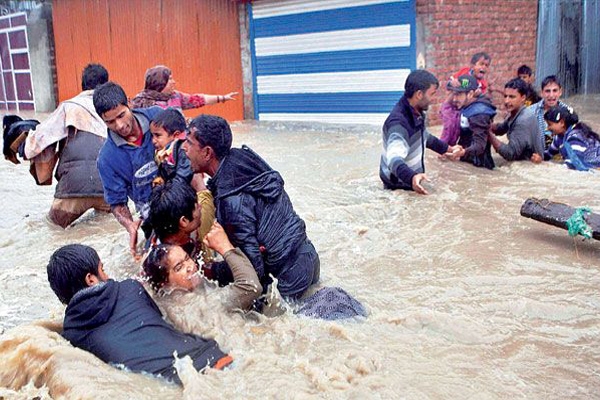
(Image source from: What caused the worst floods in Jammu and Kashmir?})
Jammu and Kashmir has been ravaged by the worst floods in its history in 100 years. The primary cause of the flood has been attributed to unprecedented rainfall, unplanned urbanisation and a complete lack of preparedness by the state government, according to an analysis by the Delhi-based Centre for Science and Environment (CSE).
The analysis by CSE suggests that the devastating floods could also be a manifestation of changing climate, indicated by the extreme weather.
CSE director general Sunita Narain laid the blame on unprecedented rainfall combined with lack of proper drainage due to unplanned urbanisation and total absence of preparedness.
The magnitude of the disaster in Jammu and Kashmir, like in other previous cases of extreme rainfall events, has been increased manifold due to unplanned development, especially on the riverbanks.
The CSE report reveals that the last 100 years has seen over 50 % of the lakes, ponds and wetlands in Srinagar being encroached upon for constructing roads and buildings. Similarly, the banks of the Jhelum river were encroached, greatly reducing the carrying capacity of the river. These areas were the worst affected.
Jammu and Kashmir is totally unprepared to deal with a calamity of such magnitude. The state doesn't have a flood forecasting system and also has a rudimentary disaster management system, according to CSE.
Floods in Kashmir are a grim reminder to the country that climate change has begun to affect India. The country has been hit hard by several extreme rainfall events in the last 10 years, and the Kashmir floods id the latest calamity in that series" said CSE deputy director general Chandra Bhushan.
The list of such extreme events compiled by CSE researchers includes the Uttarakhand floods of 2013, Leh cloudburst of 2010 and Mumbai floods of 2005. Thousands of people have died in each of these disasters. Besides the country has incurred economic losses running into thousands of crores of rupees, said CSE.
The CSE report highlighted that the major cause of Jammu and Kashmir floods was "unseasonal and extreme rainfall". In fact at many places in the state it rained over 200-mm in 24 hours, which is almost 400 % more than the monthly average.
However, the CSE says the Indian Meteorological Department has rejected that climate change has anything to do with the calamities in Uttarakhand, Leh, Mumbai or in Jammu and Kashmir.
According to the CSE most climate models have predicted that India will increasingly be affected by extreme rainfall events in the coming decades due to global warming.
India would be hit by increasing incidence of floods and droughts. But the continued denial by the Indian Meteorological Department as well as the Ministry of Environment and Forests & Climate Change will hurt the country more. The think tanks in the country need to accept that climate change is impacting India, said CSE.
(AW: Pratima Tigga)