(Image source from: Hindustan Times)
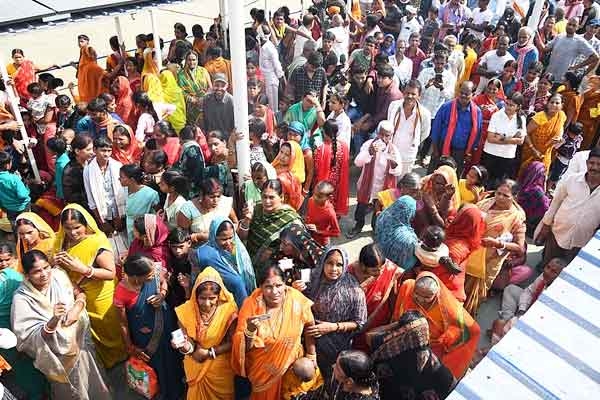
Voting for the first stage of the 2025 Bihar Assembly elections saw a temporary voter participation rate of 64.66 percent, which is the highest ever recorded in the state’s history. Previously, the highest turnout for an Assembly election in Bihar was 62.57 percent in the year 2000. Regarding Lok Sabha elections, the maximum turnout for the state was 64.6 percent in 1998. Chief Election Commissioner Gyanesh Kumar expressed gratitude to voters for their high participation and acknowledged the hard work of polling staff. The rise in voter participation is particularly notable because the thorough revision of the state's voter lists—a controversial action criticized by opposition as an effort to limit voters from disadvantaged groups who typically support them—removed 47 lakh names. The decrease in the overall number of voters—from 7.89 crore to 7.42 crore after this revision—might explain the higher turnout percentage, but only if the actual number of voters remains unchanged.
For instance, if in the election before the revision 60 out of 100 individuals voted, there would be a 60 percent turnout. After the revision, if the number of qualified voters is reduced to 80, and the same 60 individuals vote, then the turnout percentage becomes 75 percent. Conversely, if only 40 people cast their votes, the turnout drops to 50 percent. Apart from the effects of the revision, it is commonly believed that high turnout rates often reflect dissatisfaction with the current government, which the opposition is hoping for, further supported by the offer of a job for every household.
This pattern has been observed in the last three Bihar elections. In 2010, Nitish Kumar's Janata Dal United teamed up with the Bharatiya Janata Party for a significant victory; the voter turnout during that election was 52.73 percent, with the JDU winning 115 seats. Before the 2015 election, he changed his strategy by aligning with his former rival Lalu Yadav's Rashtriya Janata Dal. In this election, voter turnout increased by 4.18 percent, leading to a win for the Kumar-Yadav coalition.
Five years later, Kumar changed his stance again, going back to the BJP, and his coalition won once more, though the JDU lost 28 seats from the previous count and had to accept being a 'junior partner.' At that time, the total voter participation was 57.29 percent, which was 0.38 percent higher than the last election. The turnout in the first phase of the 2025 election is 7.37 percent above the overall turnout from 2020 and 8.46 percent more than the first phase from that year, which had 56.2 percent. In fact, today's turnout exceeded the numbers at every point compared to the first phase of the 2020 election. The turnout at 9 am was 13.13 percent in contrast to 7.1 percent during the first phase of the last election, and by 1 pm, it was 42.3 percent compared to 33.1 percent. At 5 pm, the figure reached 60.1 percent, whereas it was 51.8 percent in 2020. According to common belief, today’s turnout could be seen as encouraging for the opposition and for Congress and RJD's Tejashwi Yadav, who would be the chief minister if the Mahagathbandhan wins a majority. However, high voter turnout doesn’t always mean a loss for those in power.
For instance, in Chhattisgarh, voter turnout rose by almost seven percent from 2008 to 2013, yet the Bharatiya Janata Party won both times. Similarly, in Madhya Pradesh between 2003 and 2013, voter turnout increased from 67.25 percent to 72.07 percent, but the BJP claimed victory in all three elections. Additionally, the effects of updating voter lists and removing 4.7 million names must be taken into account.
There is still one more round of voting to occur. Today, only 121 of the 243 seats in the state cast their votes. The remaining 122 will vote next week, on November 11, with the results being revealed three days later, on November 14. Meanwhile, Tejashwi Yadav was among a few prominent names participating in this round. He contested from the stronghold of Raghopur, which has supported his father, Lalu, and his mother, Rabri Devi, seven times out of the last nine elections. Yadav has represented this seat since 2015.
Other notable seats that voted today included Tarapur, where Deputy Chief Minister and BJP state leader Samrat Choudhary ran, Alinagar, where popular folk artist Maithili Thakur is the BJP candidate, and Mokama, where drama ensued following JDU candidate Anant Singh's arrest in a murder case. After the 2020 election, the RJD became the largest single party with 75 seats, just one more than the BJP. The JDU came in third with 43 seats, while Congress, an ally of the RJD, was fourth with 28 seats.