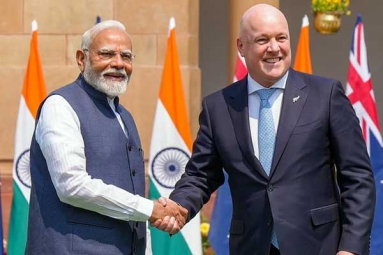
(Image source from: x.com/BJP4India)
Prime Minister Narendra Modi stated on Tuesday that India has joined the "Reform Express," highlighting many policy changes made throughout 2025 in areas like taxes, labor, trade, energy, education, and rural jobs. In a message on X, the Prime Minister mentioned that these reforms have given new energy to India's growth journey and will help in achieving the vision of a developed India. PM Modi wrote, "India has joined the Reform Express! 2025 saw remarkable reforms across different areas, adding speed to our growth journey. They will also support our goal of creating a developed India." In a detailed post on LinkedIn, PM Modi explained that 2025 is a year when reforms were treated as an ongoing national mission.
"2025 will be a memorable year for India, emphasizing reforms as a continuous effort that builds on what we have achieved over the last 11 years. We improved institutions, made governance easier, and laid a solid foundation for long-term, inclusive growth," he stated. One of the major changes he pointed out was a significant update to the Goods and Services Tax. A simpler GST structure with two rates of 5% and 18% was introduced to decrease disputes and enhance compliance. This change helped lessen the financial burden on families, small businesses, farmers, and sectors reliant on manual labor, also boosting demand during the festive season. The government also provided considerable support for the middle class, removing income tax for people making up to Rs 12 lakh per year. The Income Tax Act of 1961 was replaced with the Income Tax Act of 2025. To assist small and medium enterprises, the definition of small companies was broadened to include those with turnovers up to Rs 100 crore, which lowered compliance costs.
India has boarded the Reform Express!
— Narendra Modi (@narendramodi) December 30, 2025
2025 witnessed pathbreaking reforms across various sectors which have added momentum to our growth journey. They will also enhance our efforts to build a Viksit Bharat.
Shared a few thoughts on @LinkedInhttps://t.co/M30VgAAAR1
In the insurance industry, complete foreign investment was permitted to enhance insurance coverage, competition, and service quality. In the capital markets, the Securities Market Code Bill was put forward to improve investor protection, governance, and reduce compliance challenges. The government also worked on reforms in the maritime and blue economy sectors by enacting five new laws during the Monsoon Session of Parliament, replacing outdated regulations and lowering logistics costs. Under the Jan Vishwas initiative, 71 old laws were repealed to eliminate unnecessary criminalization. Efforts to make business operations easier included canceling or putting on hold several Quality Control Orders to cut costs and increase exports.
Labour reforms merged 29 laws into four labor codes to balance worker protection with business needs, broaden social security coverage, and encourage women to join the workforce. On the international stage, India signed trade agreements with New Zealand, Oman, and Britain, and implemented a Free Trade Agreement with the European Free Trade Association. In the energy sector, the SHANTI Act was introduced to promote the safe expansion of nuclear energy, allow for private involvement, and meet future clean energy requirements. Rural employment guarantees were raised from 100 to 125 days under a new framework, while education reforms suggested having one single regulatory body for higher education instead of several.